
Museo Archeologico Nazionale di Canosa di Puglia - Palazzo Sinesi
Type:
Luoghi della cultura; Ente/Istituzione
Category:
Archaeology museums
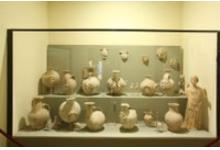
Palazzo Sines, biuilt in the 1890s and originally usedas a depository for finds from the urban area and surrounding territory of Canosa and as a venue for temporary exhibitions, since 2015, with the establishment of the Puglia’s Museum Hub, became house of the National Archaeological Museumof Canosa di Puglia. The current exhibition, renewed in 2018, illustrates with didactic and informative panels in Italian and English, a cross-section of the Canosa society between the Archaic and Hellenistic periods, one of the most important moments in the millennial history of the city.
Occupied since the Bronze Age, Canosa consolidates its position between the 7th and 6th centuries BC, until becoming together with Arpi, one of the most important centres in Daunia. Between the 4th and 3rd centuries BC evidence of its prosperity is offered by chamber tombs, used by the families of the local elite, and by their rich grave goods.
Allied with Rome since 318 BC undergoes a slow process of Romanization, becoming in the first century BC municipium and specializing in the production of wool. By the middle of the 2nd century BC, its new status as a colony led to a series of major public works.
In late antiquity, the city gained even more prestige as the seat of the governors of the Province of Apulia and Calabria under Emperor Diocletian, and as an important diocese. Sabinus, the powerful bishop of Canosa in the 6th century, ordered the construction and renovation of large numbers of buildings, surrounding the town as a protective barrier.
The archaeological exhibition is dedicated to grave goods from archaic tombs and rich hellenistic hypogea, that show us customes and attitudes of Canosa society and also the high quality of the local handicraft.The 1st room (Ram Room) contains characteristic geometrically decorated pottery known as Daunia subgeometric pottery, made in Canosa in the archaic period, together with bronze and amber artefacts, which provides evidence of commercial relations, found in the tombs from Vico Pasubio and Via Legnano (6th – 5th century BC).
In the 2nd room (Krater Room) there are grave goods from the hypogeum of Vico San Martino (4th – 2nd century BC) feature Apulian red-figure pottery and other prestigious items such as weapons and metals.
The next rooms contain the rich collection of grave goods from the Varrese hypogeum, one of the most important chamber tombs in Canosa, which belonged to several generations of one of the town’s prominent families.
In addition to the Apulian-red figured vases characterized by monumental dimensions, rich decorations and by the narrative substance of the scenes portrayed, widely featured in the grave goods of the Varrese hypogeum are the canusian ware vases, characterized by polychrome images tempera-painted and by plastic decorative elements applied.
Contacts:
-
Spatial coverage:
Via Kennedy, 18 - 70053, Canosa di Puglia (Barletta-Andria-Trani), Puglia - Italia