
Museo archeologico "Oreste Nardini"
Type:
Luoghi della cultura; Ente/Istituzione
Category:
Archaeology museums
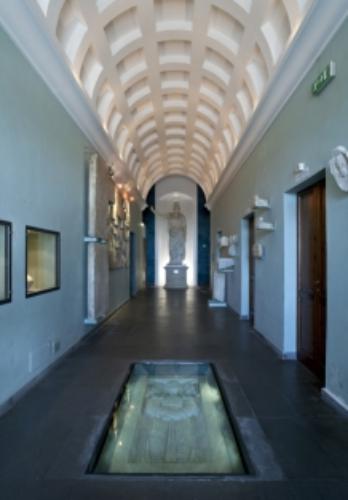
Instituted in the first years of the 1900s, the Museum preserves the most ancient and precious historical-archaeological evidence of the Velletri territory. The collection is composed of the most ancient nucleus, the Nardini collection, and works that were added later. About seven hundred finds belong to the first nucleus: the terracotta architectural sheets (6th century B.C.) belonging to an Etruscan-Italic temple and the Sarcophagus of the prayer (4th century A.D.), and a tomb stone with scenes from the Old and New Testament are of particular interest. During the 1900s, important finds converged in the civic collection, such as the monumental Sarcophagus of the labours of Hercules (2nd century A.D.), and the Civitana Sarcophagus (3rd century A.D.). The first is also known as the Sarcophagus of Velletri, and is surely one of the most significant works of Roman art: "mythical" for the beauty of the rich decoration, and "mythical" for the different myths to which the represented theme connects (myths of Hercules, Protesilao, Proserpina and Alcesti). In 2003, the collection was enriched with the Pellegrini donation, a nucleus of one hundred and seventy fragments of Campana sheets, simas, covering sheets, and coping blocks coming from Madonna degli Angeli, where, by tradition, Villa degli Ottavi was located and the future emperor Cesare Ottaviano Augustus spent his childhood.
Spatial coverage:
Via Goffredo Mameli, 6 - 00049, Velletri (Roma), Lazio - Italia
Condizioni d'uso della risorsa digitale:

Quest'opera di MetsTeca è distribuita con Licenza Con attribuzione, no opere derivate, senza riuso commerciale.
Previews
Relations
Is referenced by: consulta la scheda dell'Anagrafe Luoghi della Cultura
see website
Certificato Herity
Has part: View resource contained
View resource contained
Provider
MuseiD-Italia / --Museo archeologico "Oreste Nardini"
Identifier: mus_2384
Rights
Metadata license: Pubblico dominio