
Area archeologica di Nora
Type:
Luoghi della cultura; Oggetto fisico
Category:
Archaeological areas; Archaeology museums
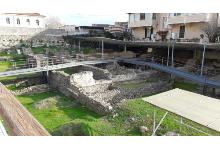
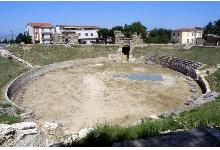
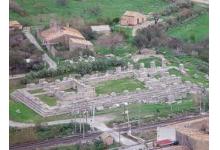
Nora was founded by the Phoenicians at the end of the 8th or the 7th century BC (it depends on different interpretations) on the charming promontory of Capo di Pula, between sea and pools. In the ancient Phoenician, Punic and then Roman trade centre we can see the Phoenician necropolis, the inhabited centre and the Punic tophet.
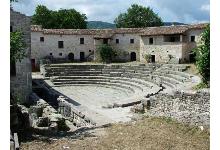
A beautiful theatre (beginning of the 1st century BC), one of the best preserved buildings of Nora, rises among the ancient paved streets. Imposing are the thermal baths, often decorated with splendid mosaics that date back to the 2nd- 4th century AD. Important religious buildings are the Punic temple of Tanit, in the homonymous hill, temple n.6 and the sanctuary of Aesculapius (2nd-3rd century AD).
Many private buildings, often with water tank and built with opus caementicium and africanum, are often particularly prestigious, as the house with tetrastyle atrium and mosaics dating from the 3rd-4th century AD. The forum is near the sea, and still keeps the base of honorary statues of famous people. After a long period that started in the 5th century AD, the city was definitely abandoned in the 8th century because of pirate and Vandal raids. From the end of 1800 the city was brought to light by the researches of Nissardi and Vivanet and then by the excavations in 1952. From the site of Nora, one of the most important in the south of Sardinia, comes one of the most valuable finds of Sardinian archaeology, the famous Stele di Nora (end of the 9th-beginning of the 7th century BC), where we find the most ancient mention of the name Sardinia.
Accessible to disabled people.
Contacts:
website: https://www.nora.sardegna.it/ - email: cop.tur01@gmail.com - tel: +39 070 9209138 - fax: +39 070 921471
Spatial coverage:
Nora, Viale Nora - 09010, Pula (Cagliari), Sardegna - Italia