
Palazzo dei Priori
Type:
Luoghi della cultura; Oggetto fisico
Category:
Museums
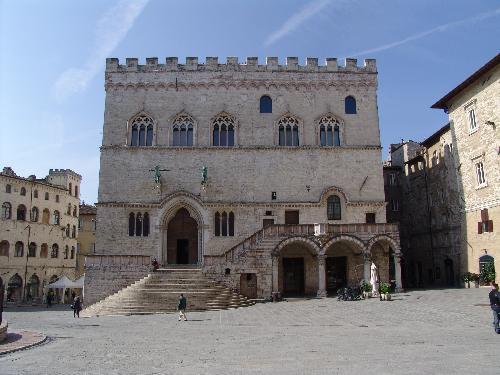
Priori Palace Palazzo dei Priori is the historical palace that stands at the corner of Piazza IV Novembre and Corso Vannucci, in Perugia. It was the seat of the Priori— i.e. outstanding citizens—the highest political authority of the town in medieval communes, and as such it was decorated in the course of the years by the best artists of the time. A first nucleus of constructions, dating back to the 1270s, was already built. Starting from the last decade of the 13th century, the “palatium novum populi” began to develop around the architectural complex of private property. Its execution would be terminated in subsequent stages, resulting in an irregular architectural body, rich with asymmetries and movement. A first nucleus of the palace, built between 1293 and 1297, is defined by the three trifore—the three-lancet mullioned windows—on the second floor above the portal overlooking the square, and the ten trifore overlooking Corso Vannucci. During the first expansion—1333-1337—two trifore next to the portal and a straight staircase were added to the façade facing the square. The straight staircase was a work of Ambrogio Maitani, while the semicircular staircase we see today dates from 1902. Later on, the volume to the right was added encompassing the pre-existing Church of San Severo della Piazza, preferring to have a portico with irregular arches. In 1353, the palace construction extended to the current Via dei Priori. The building extension continued in the next century with a bridging arch bypassing Via dei Priori, also encompassing a medieval tower. A further extension was added on, between 1429 and 1443. Walking up the stairs facing the square, entering inside, through the Gothic-arched portal surmounted by copies of the 13th century bronzes of the Griffin and the Lion—the original symbols of the town are kept inside the palace—one enters into the Sala dei Notari, the Hall of the Notaries’ Guild. Originally the hall of the popular assemblies, it is a rectangular vaulted room supported by eight huge Romanesque arches, and is entirely frescoed depicting legends, tales and Biblical stories that can be dated from the last decade of the 13th century—probably the work of the Master of Farneto and the Master Expressionist of Santa Chiara—and with coats of arms of the Podestà and the various Captains of the People, who governed the town. The façade on Corso Vannucci, apart from presenting the trifore and the quadrifore—four-lancet mullioned windows—that lighten the heavy body-mass of the wall, has a rich round arched portal, probably dating from the 14th century, sided by pilasters supported by Lions where allegoric representations are featured: on the left pilaster Magnanimity, Fertility and Pride; on the right pilaster, Greed, Opulence and Humility. Two Griffins surmount the pilasters and both subjugate Calves, which symbolize the Guild of the Butchers, who commissioned the work, while Scenes of the life of Man are represented on the arch. In the lunette, there are copies of the statues of SS Louis of Toulouse, Lawrence and Herculanus, the originals are kept in the National Gallery of Umbria. On the First Floor of the palace, seat of the Municipality, there are several frescoes. Those of Bernardino Pinturicchio, in the Council Hall, are especially noteworthy. On the Third Floor, seat of the National Gallery of Umbria, there is the Priori Chapel, frescoed by Benedetto Bonfigli with Stories from the Life of St Louis of Toulouse and St Herculanus (1454-1480). In the same building, along Corso Vannucci, there is the Collegio del Cambio—the seat of the Guild of the Moneychangers that conserves precious frescoes executed between 1498 and 1500 by Pietro Vannucci, called il Perugino, one of the highest exemplifications of the Renaissance Italian Art—and the Collegio della Mercanzia—the seat of the Guild of the Merchants—inside an elegant room all covered with wooden panels of carved poplar wood, probably the work of some craftsmen from transalpine countries.
Spatial coverage:
Corso Vannucci, 16 - 06121, Perugia (Perugia), Umbria - Italia
Condizioni d'uso della risorsa digitale:

Quest'opera di MetsTeca è distribuita con Licenza Con attribuzione, no opere derivate, senza riuso commerciale.
Previews
Relations
Is referenced by: consulta la scheda dell'Anagrafe Luoghi della Cultura
Palazzo dei Priori. Facciata su Corso Vannucc
Palazzo dei Priori. Facciata, Portale (1346).
Palazzo dei Priori. Sala dei Notari (1582).
Palazzo dei Priori. Sala dei Notari, arconi t
Palazzo dei Priori. Interno. Il grifo perugin
Palazzo dei Priori. Sala dei Notari, affresco
Provider
MuseiD-Italia / --Palazzo dei Priori
Identifier: mus_8030
Rights
Metadata license: Pubblico dominio