
Abbazia di San Giovanni in Venere
Type:
Luoghi della cultura; Oggetto fisico
Category:
Religious buildings; Art museums
The abbey of Saint John in Venere is located in a suburb of the town of Fossacesia, on a promontory that dominates the surrounding fields and the seacoast, called Costa dei Trabocchi.
The attribute in Venere is possibly due to the presence of a Roman temple dedicated to the goddess Venus, of which no architectonical elements survived, but only the place name.
Between the 8th and the 10th centuries, only a simple monastic cell is attested. The real abbey was built in 1015, possibly by Trasmundus II, Count of Teate (ancient Chieti), whose body is buried in the crypt of the churchs abbey. The current appearance is due to the transformations carried out between 1165 and 1204 by abbot Odorisius II and between 1225 and 1230 by abbot Rainald.
Currently the abbey is occupied by a community of Passionists.
On the outside, the visitor can see the details of the solid faade of the abbeys church - built with sandstone blocks on the lower part and with bricks on the upper one - and spend a little time to admire the magnificent main gate, called Gate of the Moon because during the summer solstice it is reached by the sunset sun rays that enlighten the presbytery and the crypt. The Gate of the Sun is represented by the small windows on the three apses, crossed by the sun rays during the winter solstice.
In the lunette on top of the main gate there is a high-relief depicting Christ on a throne, Saint John the Baptist and Saint Benedict of Norcia, while the large marble pillars on the sides of the gate are masterfully engraved with stories of Saint John the Baptist.
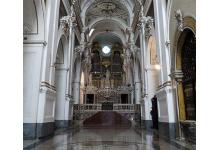
The inside of the church is divided into three naves and has a high presbytery, under which there is the crypt, decorated with evocative frescoes representing Christ Blessing and the Virgin Mary on a throne, made by unidentified artists in the 1200s, possibly members of the atelier of the artist Jacopo Turriti, from Rome.
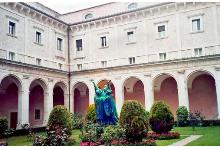
The visit can end in the bright three-sided cloister, built in the 1200s and decorated with elegant three-mullioned windows. It was partially re-built between 1932 and 1935 and it is accessible through the gate in the left nave of the church or through the main access of the monastery. Among the stone artifacts exposed in the cloister there is a particularly interesting inscription of Oderisius II, that attests the construction of the church of Saint John in Venere in 1165.
For guided tours, please contact Dr. Gabriella Carlini: tel.+39 0872 608294; cell.+39 329 0156510
Spatial coverage:
via di San Giovanni in Venere, s.n.c. - 66022, Fossacesia (Chieti), Abruzzo - Italia