
Palazzo d'Avalos - Musei civici
Type:
Luoghi della cultura; Ente/Istituzione
Category:
Archaeological parks; Archaeology museums; Art museums
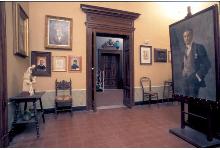
The palace, situated more than one hundred meters above the town, overlooks the coast of Vasto, like a monolith of white squared stone. Located behind the Cathedral and on the edge between the two parts of the old town, the Roman settlement and the Medieval township, the palace was founded by the military leader and lord of Vasto Giacomo Caldora, probably in the Twenties of the fifteenth century. Not much remains of the original aspect: the overall plan, centered on a wide central yard and few traces of the external walls. Nevertheless the extant mullioned window with two lights and the remains of the portal attest fairly well the elegance of the architectural and decorative arrays. When the Guevara family ascended the power in the town, they probably completed the construction of the palace, especially on the side facing the sea. In 1496 the town fell into the hand of the D'Avalos, who used the palace for more than three centuries as their residence and made of it the seat of the town authorities. In 1566 the Turks invaded Vasto, sacked the town and damaged the palace, taking advantage of the absence of the Marquis Francesco Ferdinando, who had moved to Palermo after being appointed as viceroy of Sicily. His wife, Isabella Gonzaga, daughter of the Duke of Mantova, after her husband's death, ordered the reinforcement and reconstruction of the building, which started in 1573 and did not end before the beginning of the following century. Nonetheless the golden age of the palace was the eighteenth century. The new owners, the family Lante della Rovere, enriched the rooms and made of the palace the seat of a little but lively court. At the time of the French invasion, a period of decay started for the fortress and during the nineteenth century some rooms were demolished or employed for different uses. As from the Sixties of the twentieth century a gradual revival began for D'Avalos Palace, which is today the seat archaeological and art cllections. The municipal art collection is situated in the eastern and southern rooms of the first floor of D'Avalos Palace and contains works byDonnini, Moccioli, Michetti, Brill e Palizzi.
The archaeological collection is divided in five halls nd includes archaeological finds from the Iron Age to the Early Middle Ages, which give evidence to the development of the town of Histonium, the ancient name of Vasto and of the area where the pre-Roman people of the Frentans had settled.
In the first rooms there are finds dated from the tenth to the first century B.C.: funeral sets from the necropolises of the Trattuto and of Villafonsina, votive earthenware from the temples of Villafonsina and Punta Penna, a series of bronze statues and a numismatic collection.
The second hall is dedicated to the development of the town of Histonium in the early imperial age (I century A.D.): there are portrays of the Julian-Claudian gens, sarcophagi and amphorae.
The third room concerns the growth of Histonium in the mid imperial age (I-II century A.D.): it contains remains of the amphitheater, of the aqueduct, of the cisterns and of mosaic baths; there are also oil-lamps, branded bricks and a female bust of excellent workmanship.
The fourth hall is reserved to the funeral arrays from the most important necropolises of the town: the area of Largo Barbacane, that of the town hall, the Caldoresco Castle.
In the last rooms there are remains of the late imperial age and of the early Middle Ages: epigraphs, coins and a ciborium from a seventh-century church.
Spatial coverage:
Piazza Lucio Valerio Pudente, 1 - 66054, Vasto (Chieti), Abruzzo - Italia

Condizioni d'uso della risorsa digitale:

Quest'opera di MetsTeca è distribuita con Licenza Con attribuzione, no opere derivate, senza riuso commerciale.
Previews
Relations
Is referenced by: consulta la scheda dell'Anagrafe Luoghi della Cultura
see website
Palazzo D'Avalos, facciata
Has part: View resource contained
View resource contained
Provider
MuseiD-Italia / --Palazzo d'Avalos - Musei civici
Identifier: mus_9215
Rights
Metadata license: Pubblico dominio