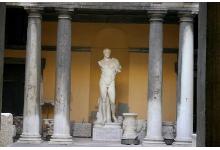

Museo Nazionale Jatta
Type:
Luoghi della cultura; Ente/Istituzione
Category:
Archaeology museums
The Museo Archeologico Nazionale Jatta is a very rare example of nineteenth-century private collections whose original museographic concept has remained unchanged. Inside the museum, the architectural design, furnishings and ideas that inspired its building over the course of the 19th century are still visible.
The establishment of the Museum and its additions during the 1800s are closely linked to prominent members of the Jatta family: the brothers Giovanni Sr and Giulio Jatta, who founded the institution, Giulio’s wife, Giulia Viesti and Giulio’s son, Giovanni Jr, author of the “Catalogo della Collezione” (Naples, 1869).
The unchanged relationship between the contents and their “container”, preserved until today, reflects the cultural climate of the 19th century. The Museum’s contribution to rebuilding the social and civilian history of the city of Ruvo in the 1800s was officially confirmed when it was acquired by the Italian Government with two deeds of purchase, on 19 December 1990 and 10 April 1991, respectively.
The exhibition occupies four halls on the ground floor of the building. In fact, the Museum was designed to accommodate a collection of over 2000 archaeological artefacts, thereby turning this into one of Apulia’s richest and most renowned museums. The first hall, in which a Latin inscription commemorates the museum’s founders, displays mostly Peucetian clay pottery decorated with geometric patterns, dating back to the 7th and 6th centuries BC.
The second hall holds about 700 red-figure on black background vases manufactured locally or originating from Greece. Among them, a large krater with masks by the Baltimore Painter dates from the 4th century BC.
The third hall, which houses over four hundred pieces, contains a white marble bust of Giovanni Jatta Jr, one of the Museum’s founders.
The fourth hall contains the most valuable relics. Here, too, stands a marble bust of Giovanni Jatta Sr, in toga garb. The most important vessel in this room is that of Talos, the giant in charge of protecting the island of Crete.
Contacts:
responsible: Claudia Lucchese - website: http://www.musei.puglia.beniculturali.it/ - email: drm-pug.museoruvo@beniculturali.it - tel: + 39 080 3612848
Spatial coverage:
piazza G. Bovio, 35 - Ruvo di Puglia (Bari), Puglia - Italia